


The Main Stage Is the Goal, but the Path Starts Earlier Than Most Founders Expect
TechCrunch Disrupt’s Startup Battlefield remains one of the most contested application processes in early-stage venture, with founders across every sector lining up for a shot at the Disrupt Main Stage. The competition draws applicants who understand that the stage itself carries weight – investor attention, press coverage, and a direct line to an audience that includes some of the most active check-writers in the industry. What fewer founders appreciate is that the value attached to Startup Battlefield does not begin when a company is selected for the Top 20.
The opportunity structure is layered.
From the moment a company enters the Battlefield process, it gains access to resources, visibility, and networks that exist entirely outside the Main Stage spotlight. Understanding that distinction changes how serious founders should treat the application – and how early they should start preparing for it.
How Selection for the Top 20 Actually Works
TechCrunch’s editorial and events teams evaluate Startup Battlefield applications with a specific set of criteria in mind. The process is not purely about the novelty of an idea or the size of an addressable market on paper. Companies that make the Top 20 tend to demonstrate a combination of factors: a clear problem being solved, evidence that the founding team has the background to execute, and a product or prototype that moves beyond deck-level abstraction. Judges want to see that something real exists, not a vision waiting for funding to become real.
Timing matters in ways that go beyond the application deadline. Founders who engage with the Battlefield process early – before the cutoff, before the judges are assigned, before the finalist list is drawn – give themselves room to refine their positioning. A company that rushes an application because it spotted the deadline two days out is competing against teams that have thought carefully about how they communicate their product, their traction, and their differentiation. That gap shows up in the written submission before it ever shows up on a stage.
The Top 20 designation itself carries immediate credibility. Being named a Startup Battlefield finalist at TechCrunch Disrupt is a data point that follows a company through its fundraising conversations. Investors who were not in the room will see the credential. Partners who were not paying attention during the event will ask about it afterward. The selection functions as a third-party signal at exactly the stage in a company’s life when third-party signals are hardest to come by – before revenue scales, before a Series A closes, before the market has had time to validate the product publicly.
What Every Applicant Gets, Regardless of Whether They Make the Top 20
The Startup Battlefield application process is not a binary outcome where only finalists walk away with something useful. Every company that applies and participates in the broader Battlefield program receives access to the Disrupt event itself, exposure to the TechCrunch editorial network, and the ability to engage with the community that assembles around the conference. For early-stage founders, that network access is not a consolation prize – it is frequently the mechanism through which early customer conversations, advisor relationships, and seed-stage introductions happen.
TechCrunch has structured the Battlefield program to extend value across its participant base rather than concentrating it entirely at the winner’s podium. That structure reflects a practical reality about how early-stage companies develop: most consequential startup relationships do not happen on a main stage in front of thousands of people. They happen in hallways, at side events, in the margins of a conference where a founder ends up in the right conversation at the right moment. Battlefield participation creates the conditions for those moments across a wider group than just the finalists.
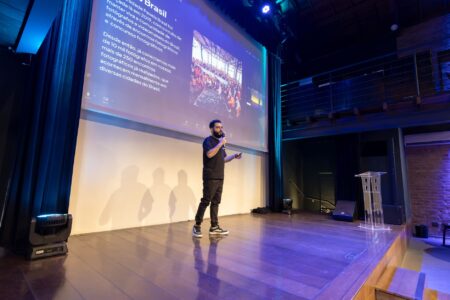
For the companies that do make the Top 20, the Main Stage appearance adds a public dimension to what is otherwise a network play. They pitch in front of a live audience that includes journalists, investors, and other founders. The pitch is recorded, distributed, and referenced long after the event ends. Winners receive the Startup Battlefield prize, and the entire finalist cohort enters a category of company that TechCrunch tracks and covers on an ongoing basis. That post-event coverage is part of the package, not an afterthought – and for a startup trying to build momentum heading into a fundraising round, a warm editorial relationship with a major tech publication is worth accounting for in the decision of whether and how seriously to pursue the application.

Why Founders Should Treat the Application as a Strategic Exercise
There is a version of the Startup Battlefield application that founders treat as a lottery ticket – submit something, see what happens, move on. That approach misses the point of what the process is designed to surface. The criteria used to evaluate applications are not arbitrary. They map closely to what early-stage investors look for in an initial meeting: founder credibility, problem clarity, market understanding, and product evidence. A founder who works through the application seriously ends up with a sharper version of their pitch, a cleaner articulation of their value proposition, and a clearer sense of where their story has gaps.
That sharpening process has value independent of whether the company is selected. Early-stage startups navigating competitive markets – where the distance between a compelling pitch and a passed opportunity can be a single unclear sentence – benefit from any structured exercise that forces tighter thinking about positioning. The Battlefield application is one of those exercises, and it comes with the upside of actual selection if the company is genuinely ready.
The application window for Startup Battlefield opens well in advance of the Disrupt event date. TechCrunch makes the timeline public and encourages early submission. Founders who wait until the final week are not just competing against the clock – they are competing against teams that have had more time to think, revise, and stress-test how they present their company to an external audience seeing it for the first time.
The Disrupt Main Stage can change a company’s trajectory. But the Startup Battlefield program is built so that trajectory can start shifting before a single finalist is ever announced – and whether or not a company’s name ends up on that Top 20 list, the question of how seriously a founder took the process is one they will answer either way.